Private label vitamin D supplements for UK brands: formats and costs
The strength is only one part of a Vitamin D3 launch. For private label vitamin D supplements in the UK, selected stock white-label lines may have minimum order quantities of 500–1,000 units. The cost depends on the formulation, packaging and order volume, so a 3,000 IU concept needs to be considered alongside its format and brand positioning. The price depends on the project and is provided after a quote request.
You may already have a target strength in mind; the challenge is turning it into a product and order that make commercial sense. This guide explains Vitamin D3 options, available formats, minimum order quantities and branding, then shows how those choices affect costs. You’ll have a clearer view of the decisions involved in taking a private-label supplement from an idea towards a market-ready product.
Table of Contents
Your own private label Vitamin D3 capsules softgels 3000IU?
A 3,000 IU concept starts with a product decision, not just a strength. Decide whether you need an existing formulation or a distinctive specification, then match the format, ingredient source and pack to your intended customers. Private label vitamin D supplements in the UK can use a manufacturer’s existing formulation under your brand, with manufacturing and packaging handled through a contract arrangement.
Which vitamin D health claims are permitted on UK supplement labels? Keep label wording focused on vitamin D’s role in the normal functioning of the body, including its contribution to the maintenance of normal bones, teeth and muscle function. Do not present a supplement as a treatment for a health condition.
Product specifications need to be precise. One Vitamin D3 2500IU capsule contains 62.5 μg of vitamin D3, equivalent to 2500 IU, alongside 150 mg of vitamin C and 100 μg of vitamin K2 MK-7. Its shell contains 40 mg of vegetable cellulose. The manufacturer says that bottle contains 50% more capsules than its Vitamin D3 Plus blend. These details illustrate why brands should compare the complete formula, not just the Vitamin D3 strength.
What risks should brands consider when sourcing private label vitamin D supplements? Check the ingredient source, formula specification, dosage information, label wording and consistency between the agreed product and the supplied batches. Resellers must tell consumers the product’s maximum recommended daily dose, so include this information in label planning.
Ingredient source affects product positioning. Lanolin-derived vitamin D comes from an animal source, so it is unsuitable for vegans. It is described as cost-effective and highly bioavailable. Algae-derived vitamin D is vegan-friendly and may appeal to environmentally conscious consumers, but is less available and more expensive to produce. Vitamin D from foods such as oily fish, egg yolks and red meat is another sourcing route, but its relatively low concentrations and limited manufacturing scalability make it a different proposition.
Production methods also vary. UV light can convert precursor molecules into active forms of vitamin D. One described algae extraction method uses water, plant ethanol and pressure, while lanolin processing begins with cleaned sheep’s wool. Understanding the ingredient pathway helps you decide whether a formulation fits your brand’s sourcing priorities.
A UK private-label vitamin supplement manufacturer directory can help map potential production partners, but its figures need context. Among matched UK companies, the average was 11.1 tracked professional contacts per company as of 30 September 2026, while the median employee-size band was 11–50. London represented 16.7% of matched companies; the UK manufacturer list contained 29 London company records as of September 2026. These are directory indicators, not measures of manufacturing quality.
When comparing manufacturing partners in the UK, USA and EU, consider their production model, product formats, regulatory processes and quality controls. Define what “highest quality” means for your project by setting requirements for the formula, ingredient origin, documentation and packaging. White-label and private-label manufacturing offer different levels of customisation, while formats such as gummies and capsules can support distinct brand propositions. Choose a partner whose documented process matches your product brief.
Packaged and bulk minimum order quantities
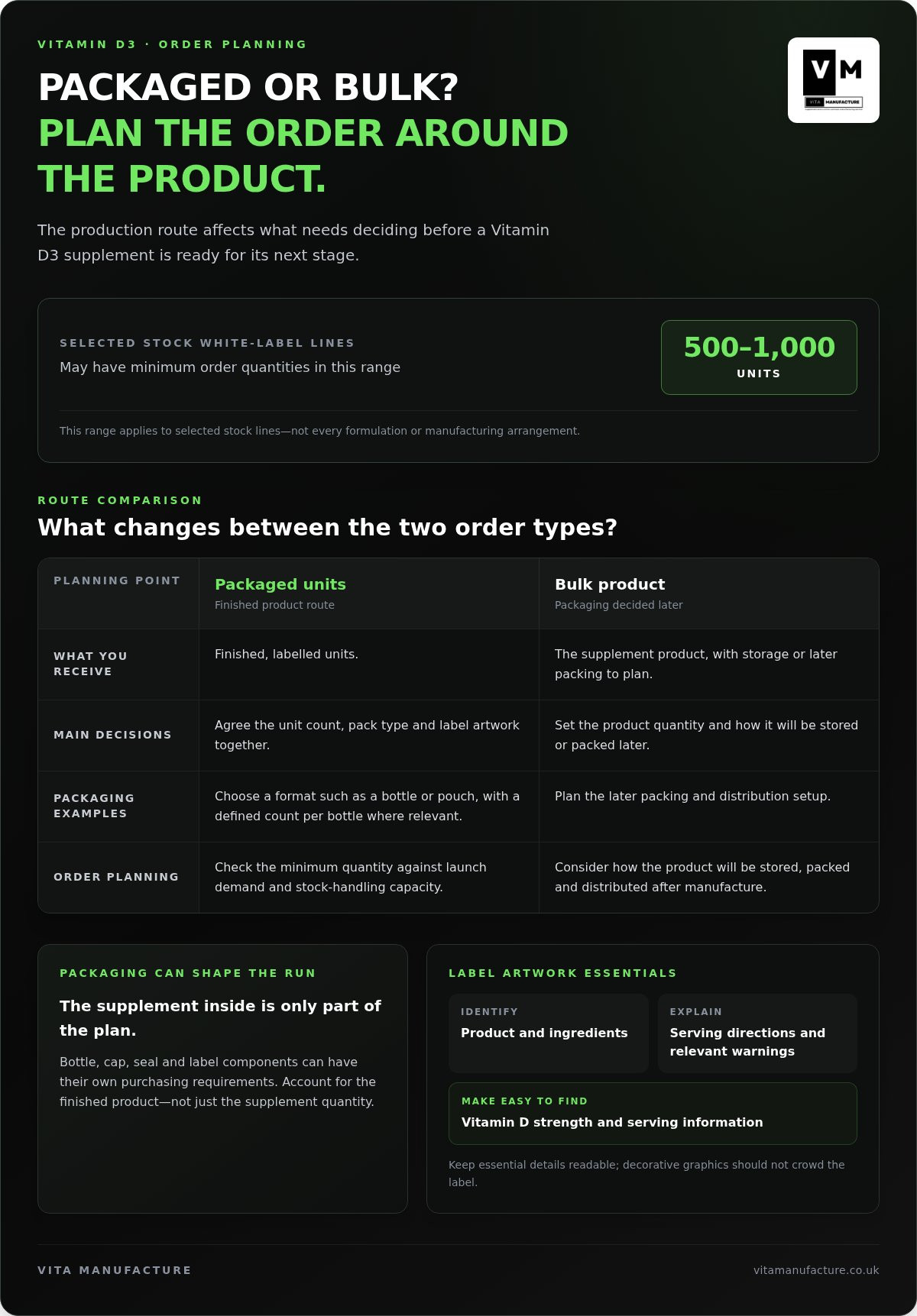
Order quantity shapes the production plan. Selected stock white-label supplement lines may have minimum order quantities of 500–1,000 units. This range applies to selected lines, not every formulation or manufacturing arrangement. A packaged order typically includes finished, labelled units; bulk supply separates product manufacture from later packaging decisions.
For a packaged product, agree the unit count, pack type and label artwork together. A Vitamin D3 capsule in a bottle, for example, needs a defined count per bottle and packaging suited to the product. Bulk orders instead focus on the product quantity and how it will be stored or packed later. The right route depends on your launch plan and fulfilment setup.
Before placing an order, map quantities across the full packaging process. Packaging components can have their own purchasing requirements, so the bottle, cap, seal and label may affect the practical production run. Ask for the plan to account for the finished product, not just the supplement inside it. This helps prevent packaging choices from driving an unexpected order size.
Packaged units: Set the number of finished products and the format, such as a bottle or pouch.
Bulk product: Plan how the supplement will be stored, packed and distributed after manufacture.
Packaging components: Match container, closure and label choices to the product and brand presentation.
Order planning: Compare the minimum quantity with your launch demand and stock-handling capacity.
Labels and packaging shape how customers understand a product. Include clear product identification, ingredient information, serving directions and relevant warnings in the artwork. Make the vitamin D strength and serving information easy to find, and keep essential details readable rather than letting decorative graphics crowd the label.
What labelling and packaging requirements apply to vitamin D supplements in Great Britain and Northern Ireland? Plan accurate product, ingredient, dosage and use information, and ensure all claims are suitable for the label. Treat Great Britain and Northern Ireland as distinct labelling markets during artwork review, assessing each version against the rules that apply where it will be sold.
Procure ingredients and packaging to match the product specification. Confirm the chosen vitamin D ingredient, format and pack materials before approving artwork, then align purchasing with the planned production run. This sequence helps coordinate supply and prevents designing around components that do not suit the finished product.
For a packaged launch, combine the formula, quantity, packaging and label brief in one production plan. Private label supplement support can bring those decisions together, including label graphic design, while keeping your brand presentation connected to the product specification.
Using existing supplement formulations and branding
Choose the formulation route that fits your launch strategy. Private label supplement manufacturing uses an existing formulation that a brand sells under its own name and packaging. For a Vitamin D3 product, this approach can give you a defined starting point: select a suitable formula, shape the brand presentation, then plan the product for your intended customers. The formulation itself is not the same as the label or visual identity.
White-label supplements use an existing formula. This lets you build your market position through branding, packaging and product communication rather than developing a formula from scratch. The route may suit a brand testing a focused vitamin D range. Before deciding how to present the product, compare its ingredients and serving details with your brief.
Bespoke formulation offers a different degree of control. Start by writing down the product’s purpose, intended audience, format and ingredient priorities. For example, a brand planning a simple Vitamin D3 product can set that as its core concept; a brand seeking a combination formula needs to define the additional ingredients and the reason for including them. In specialised sectors, such as equine wellness, brands like Healthy Horses Inside Out illustrate how everyday and specific supplement ranges are tailored to precise dietary needs. Clear priorities help distinguish essential features from optional refinements.
Adapting a standard formulation can sit between white-label and fully custom development. Decide what needs to change to make the product distinct, such as its ingredients, delivery format, serving instructions or brand positioning. Formulation changes may affect production requirements, so treat each adjustment as a product decision, not simply an artwork update. Keep the approved specification aligned with the label and finished product.
Nutrition advice can help turn a broad concept into a coherent brief. A nutrition professional can review how the proposed ingredients relate to the product’s intended role and audience. Bring them a clear outline of the Vitamin D3 concept, including the desired format and any planned combination ingredients. Their input can inform development, but it does not replace a manufacturer’s production assessment or a regulatory review of label wording.
Use this sequence to choose a route:
Define the launch: Set the target customer and the product’s highest-priority purpose.
Compare formulations: Review an existing Vitamin D formula against the brief, ingredient by ingredient.
Mark required changes: Separate must-have adjustments from preferences that can wait.
Align the brand: Match the name, packaging and label design to the selected formulation.
This process helps clarify whether an existing formulation fits your plans or whether New Product Development is a better route. A precise brief also gives your manufacturing partner a practical basis for discussing formulation, branding and production.
Vitamin formats including tablets, capsules, liquids, powders and gummies
Format shapes the customer experience and the production brief. A Vitamin D3 tablet, capsule, liquid, powder or gummy presents the same product concept differently. Your choice affects how customers take it, how you explain serving directions and how the finished product is packaged. Start product development by defining the intended user and their preferred routine, then compare formats against that brief.
Tablets provide a compact, familiar option for brands seeking a straightforward daily supplement. Capsules enclose the formulation, while softgels offer another capsule-style presentation. For example, a brand planning a simple Vitamin D3 product could compare a tablet and capsule concept before selecting its packaging. Ask how the chosen formulation fits the format and how clearly its serving information can appear on the label.
Liquids and powders offer different use experiences. A liquid may suit a brand aiming for a measured serving, with the container and directions designed accordingly. Powders may appeal to customers who prefer adding a product to a drink or food. For either format, define the serving instructions early and align the formulation, container and label with them.
Gummies offer a chewable format that can support a distinctive brand presentation. Their appearance and flavour profile become part of the product brief, alongside the Vitamin D3 formulation. A gummy concept therefore needs coordinated decisions about the product, packaging and label, rather than a format choice made after development. Keep the product’s intended role clear in customer-facing wording.
Tablets: Consider them for a compact, familiar presentation.
Capsules and softgels: Compare the shell format and finished product presentation.
Liquids: Plan the container and serving directions as one decision.
Powders: Define how customers will use the product and communicate it clearly.
Gummies: Include the chewable experience and flavour concept in the development brief.
Before launch, compare each format against the same criteria: target customer, formulation, serving instructions, packaging and brand identity. This makes trade-offs visible. For instance, a powder brief needs different packaging and use directions from a capsule brief, even when both products are designed around Vitamin D3.
Keep the specification consistent throughout development and artwork. Record the selected format, ingredients, serving information and packaging requirements in one product brief. Then check that the label explains the format and intended use clearly. This comparison helps you choose a supplement format that fits your brand proposition and gives product development a clear direction.
Costs of private label supplements
There isn’t one price that fits every product concept. The cost of private-label supplements depends on the chosen formulation, packaging and order volume. For a Vitamin D3 launch, begin by deciding whether an existing white-label formula meets your brief or whether you need a tailored formulation. Each route creates different production requirements, so compare like with like before setting your budget.
Ingredient choices shape the product specification. Algae-derived vitamin D is vegan-friendly and may appeal to environmentally conscious consumers, but it is less available and more expensive to produce. Lanolin-derived vitamin D comes from an animal source and is unsuitable for vegans. Your audience and sourcing priorities therefore influence which ingredient route makes commercial sense.
Packaging also affects cost. The bottle, cap, seal and label are part of the finished product, and different formats may require different packaging. Branding and artwork shape the pack brief too. Specify the format, ingredient source, packaging and label requirements to give costing a clear basis.
Order volume is part of the overall cost calculation. Consider it alongside expected demand, stock handling and packaging quantities. A larger run means more product to manufacture and pack, while a smaller run may suit a cautious launch plan. Compare the total project scope rather than judging the product on unit cost alone.
Formulation: State whether you want an existing formula or a bespoke concept.
Ingredients: Specify the Vitamin D source and any additional ingredients.
Format and packaging: Define the product format, container and label requirements.
Order volume: Set the production quantity against your launch and stock plans.
For an established brand, cost planning may centre on adapting an existing range or coordinating a new production run. For a new venture, prioritise essential product features. For example, settle the vitamin D source and format before refining optional packaging details. This makes trade-offs clear and helps keep the concept commercially focused.
The price depends on the project and is provided after a quote request; the formulation, ingredient choices, packaging and order volume are the key cost factors. Prepare those details in a concise product brief, then request a private-label supplement quote to move your concept forward.
Vita Manufacture: New Product Development
Vita Manufacture can turn your vitamin D concept into a defined product brief through New Product Development. This is a useful route when an existing formula, format or brand direction does not match your plans. You can explore a tailored concept or consider White Label Supplements and Private Label Supplements using an existing-formula approach. Contract Manufacturing supports production once your product direction is established.
Bring your proposed ingredients, format, target audience and packaging ideas to the discussion. These details help shape the development route and clarify decisions to make before production. If your idea is at an early stage, New Product Development can help structure the concept. For a defined product, Contract Manufacturing may be the relevant next step.
Contact Vita Manufacture to discuss your vitamin D supplement plans and decide on the next step for your product.
Move your Vitamin D concept towards launch
Your next decision is how to turn a product idea into a focused development brief. For private label vitamin D supplements in the UK, define the customer you want to reach and the role the product should play in your range. This gives manufacturing discussions a practical starting point.
Vita Manufacture offers New Product Development for brands shaping a new concept, alongside Contract Manufacturing and Private Label Supplements for production. These services can support different stages, from refining an early idea to progressing a product brief towards manufacture. Bring your product aims and brand priorities to the conversation so the next steps focus on the choices that matter to your launch.
Contact Vita Manufacture to discuss your options and take the next step towards building a Vitamin D product for your brand. A clear brief can turn ambition into a purposeful plan.
Frequently Asked Questions
Looking for a wholesaler or bulk amounts of vitamin D3?
For bulk vitamin D3, distinguish between sourcing ingredients in bulk and buying finished supplements for resale. Ingredients and Bulk Sourcing supports the former; finished goods require a product and packaging specification. For example, outline the ingredient form, intended use and whether you need loose material or ready-to-sell units. That distinction helps establish the appropriate supply route and the information needed for a useful production brief.
Which UK manufacturers offer private label vitamin D supplements?
Vita Manufacture is a UK-based manufacturer offering Private Label Supplements and White Label Supplements, including support for vitamin products. If you are exploring private label vitamin D supplements in the UK, decide whether an existing formulation fits your brief or whether the concept needs development. Vita Manufacture also offers New Product Development and Contract Manufacturing, supporting different stages from initial concept to production.
What vitamin D formats and strengths can UK private label suppliers produce?
Vita Manufacture’s dosage-form capabilities include capsules, tablets, softgels, liquids, powders, gummies, duocaps, licaps, beadlets and sachets. The target strength is a formulation decision, so include it in the product brief alongside the intended serving and format. For example, a capsule brief should state the desired vitamin D amount per serving so the formula and label information can be considered together during development.
What are the minimum order quantities and lead times for private label vitamin D in the UK?
Minimum order quantities are product-dependent and vary by formula and manufacturing process. Selected stock white-label lines may have minimums of 500–1,000 units, but that range should not be applied to every product. Lead times are determined per project. A brief that defines the format, packaging and order volume gives the production plan a clearer starting point and helps set project-specific timing.
How much does it cost to manufacture private label vitamin D supplements in the UK?
Manufacturing costs depend on the formulation, ingredients, packaging and order volume. Ready-to-go products and bespoke formulations involve different project requirements, so compare options using the same product specification. Include the format, ingredient preferences, pack design and expected order size in your planning. A quotation can then reflect the scope of your vitamin D product rather than the price or unit cost of an unrelated product.
What UK regulations apply to private label vitamin D supplements?
Vitamin D supplements are regulated as food supplements, so product development and marketing must meet applicable UK food-safety, ingredient, labelling and nutrition-and-health-claims requirements. They must not be marketed as medicines or described as treating, preventing or curing disease. Build label review into product planning, including ingredient details, dosage information and permitted claims, to keep the product specification aligned with customer-facing wording.
What quality certifications and testing should UK vitamin D supplement manufacturers provide?
Vita Manufacture is ISO 22000:2018 certified and provides quality-control testing as part of its manufacturing work. For a Vitamin D product, quality planning should connect the agreed formulation and ingredient specification with production checks and relevant records. Aligning those elements gives your brand a clearer view of how the finished product is assessed against its intended specification, without treating a certification as a substitute for product-level quality control.