European Supplement Manufacturing: A Buyer's Guide
There’s no single cost, minimum order or lead time for European supplement manufacturing: each depends on the formula, ingredients, production requirements and packaging. A Vita Manufacture supplement manufacturer in Europe can support the journey from product development through manufacturing and logistics, with the project scope shaping the practical plan. Certification also matters: Vita Manufacture states that its products comply with ISO 22000:2018.
Look beyond the production quote. To plan a supplement launch, understand what affects the schedule, how custom and ready-made formulas differ, and which packaging and quality considerations suit your brand and intended market.
This guide covers the decisions behind costs, order quantities and lead times, as well as certifications, packaging, custom formulas and ongoing support. It explains how a manufacturer’s capabilities, from product development to distribution, can shape your experience of launching or scaling a supplement business in the UK. Use it to plan clearly and choose a production route that fits your commercial goals.
Table of Contents
GMP, ISO and HACCP certification
Certification can help you assess how a manufacturer manages quality, food safety and production records. Start by distinguishing the purpose of each framework. Good Manufacturing Practice, or GMP, concerns controlled production processes. HACCP focuses on identifying and managing food-safety hazards. Different standards can address different aspects of how an organisation manages its processes. These frameworks address different controls, so one certificate does not automatically demonstrate every capability.
ISO 22000:2018 is the stated standard for product compliance in this manufacturing context. Its focus is food-safety management across relevant processes. Ask what the scope covers: a certificate may apply to particular activities, premises or product categories. Match that scope to your supplement’s ingredients, dosage form and production route. A relevant certificate gives more useful evidence than a standard name alone.
HACCP provides a practical way to assess hazards at each production stage. For a powdered supplement, that review could cover ingredient handling, mixing, contamination risks and finished-product storage. The manufacturer’s controls should link identified hazards to documented monitoring and corrective steps. Look for a clear connection between risk assessment and batch records, rather than relying on a general claim that production is safe.
GMP evidence is most useful when it applies to the process used for your product. Review how procedures address staff training, equipment cleaning, ingredient identification and batch traceability. For capsules, for example, records should link ingredients and manufacturing steps to the finished batch. Consistent documentation also supports investigation if a specification or quality concern arises.
Use a simple document review when comparing manufacturers. First, identify the standard and certificate holder. Then review the certificate’s scope, site details and validity. Finally, compare these details with the product and activities you plan to commission. This helps distinguish relevant manufacturing controls from a certificate covering another site or activity.
Companies House records the business as registered under SIC code 10890 for the manufacture of other food products not elsewhere classified. This classification describes its registered business activity, not a manufacturing certification. Companies House also lists its first accounts as due by 28 August 2027, and its first confirmation statement as due by 11 December 2026. Neither filing date demonstrates GMP, ISO or HACCP compliance.
Keep corporate records and quality documents in their proper roles. Companies House records help identify a legal entity and its filing details. Manufacturing certificates and process records address separate questions about quality systems and production. Assess whether the evidence relates to your product, manufacturing site and required production stages.
For a practical comparison, record each manufacturer’s standard, certificate scope, named site and relevant production activity. Add the controls that matter to your product, such as ingredient traceability or cleaning records. This creates a focused assessment rather than a checklist of logos. Base your decision on evidence that directly relates to your supplement’s manufacturing pathway.
Minimum order quantities and lead times
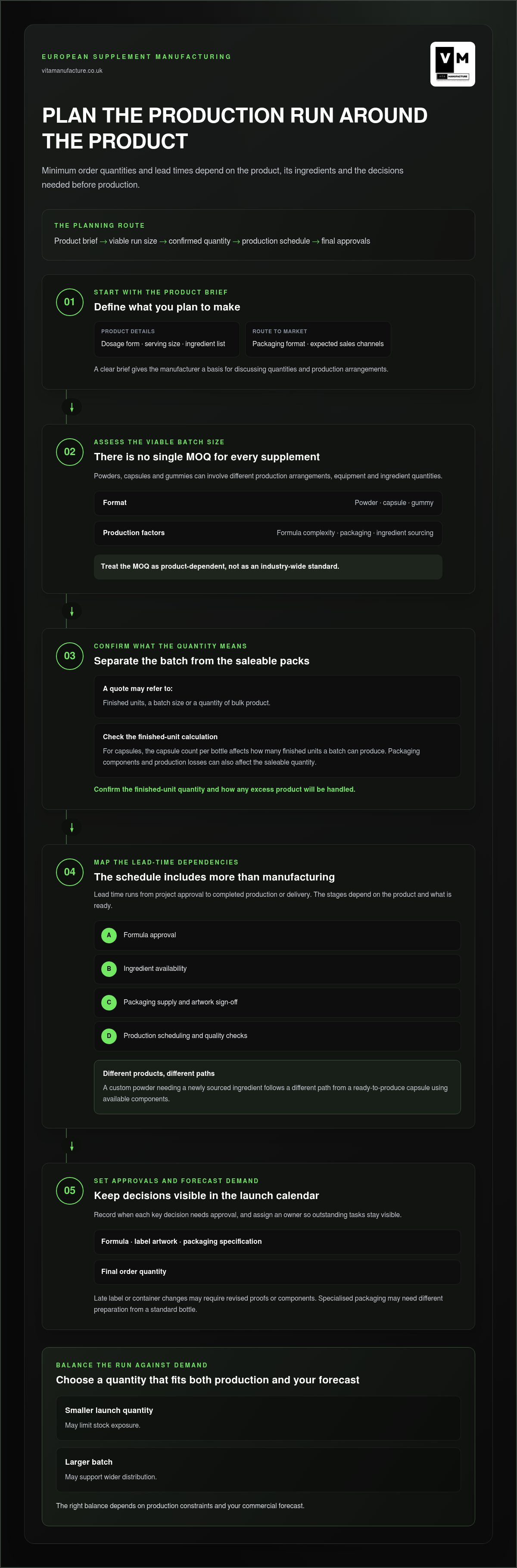
Minimum order quantities (MOQs) set the smallest production run a manufacturer will accept. There is no single MOQ for every supplement. Powders, capsules and gummies can require different production arrangements, equipment and ingredient quantities. Format, formula complexity, packaging and ingredient sourcing all affect viable batch size. Treat the MOQ as product-dependent, not as an industry-wide standard.
Clarify how the production quantity is measured. A quote may refer to finished units, a batch size or a set quantity of bulk product, and each measure affects your sales forecast differently. For example, the capsule count per bottle determines how many finished units a batch can produce. Packaging components and production losses can also affect the saleable quantity. Confirm the finished-unit quantity and how any excess product will be handled.
Prepare a product brief before discussing quantities. Include the dosage form, serving size, ingredient list, packaging format and expected sales channels. Then compare the proposed run with realistic demand. A smaller launch quantity may limit stock exposure, while a larger batch may support wider distribution. The right balance depends on production constraints and your commercial forecast.
Lead time covers the schedule from project approval to completed production or delivery. It involves dependent stages, not just manufacturing. Formula approval, ingredient availability, packaging supply, artwork sign-off, production scheduling and quality checks can all affect the final date. A custom powder requiring a newly sourced ingredient follows a different path from a ready-to-produce capsule using available components.
Build a launch calendar around key decisions. Record when you will approve the formula, label artwork, packaging specification and final order quantity. Late label or container changes may require revised proofs or components. A product with specialised packaging may need different preparation from one using a standard bottle. Set internal approval deadlines and assign an owner to each decision so outstanding tasks stay visible.
Confirm the unit: distinguish batch weight from saleable packs.
Map dependencies: connect ingredients, packaging and approvals to production.
Plan stock: compare the run quantity with your launch forecast.
Track decisions: keep formula, artwork and quantity approvals moving.
When assessing Vita Manufacture as a supplement manufacturer in Europe, frame the production discussion around your product format, forecast and packaging preferences. Consider the company against your project’s specific batch and scheduling needs. If your label is still in development, in-house label graphic design can help align the pack presentation with the agreed product details.
For a clearer production plan, bring your product format, forecast and packaging preferences into one brief. This gives a manufacturer the details needed to discuss batch size and scheduling factors. You can also review supplement production planning as you shape your launch requirements.
Packaging, label design and logistics
Packaging affects product protection, shelf presentation and fulfilment. Match the format to the supplement: capsules may suit a bottle, while powders may need a pouch or tub. Sachets can suit single servings but require their own packaging specifications. Consider how customers will store, handle and use the product before choosing a container. The choice shapes label dimensions, pack appearance and space for product information.
Prepare a packaging brief covering the product format, container preference and brand direction. Include practical details such as closure type, colour palette and label finish. A bottle label, for example, must fit its curved surface without obscuring important details. Share the brief with the design and manufacturing teams early to align artwork dimensions with the physical pack and reduce avoidable revisions during production.
Label design connects brand identity with clear product information. Organise the artwork around the product name, usage directions and ingredient details supplied for the formulation. Keep typography readable and use a consistent visual hierarchy so customers can find key details quickly. In-house label graphic design can help turn a brand brief into a production-ready layout. Check every proof against the approved product specification before sign-off.
Plan logistics alongside packaging, not after production. A bulky tub needs different storage and transport space from a compact bottle. Pack format can affect carton selection, pallet configuration and the quantities handled at each delivery point. Map the route from manufacturing through storage to distribution. Include the destination, delivery frequency and order-handling requirements so stock can move efficiently through your chosen channels.
Choose the format: compare bottles, tubs, pouches and sachets against product use.
Prepare artwork: align label dimensions, brand elements and product details.
Approve proofs: check the final layout against the agreed product specification.
Map delivery: plan storage, carton handling and distribution destinations.
Private-label and white-label products may call for different packaging approaches. A white-label launch may use an existing product with brand-specific presentation, while private-label packaging can be developed around your chosen product and identity. In either case, settle the container and artwork direction before final approval. Late changes to label size or pack type can affect production coordination and distribution preparation.
Maintain one current pack specification recording the container, label dimensions, artwork version and delivery requirements. Share the approved details with the design, manufacturing and logistics teams. This handover helps prevent confusion between the finished product and its presentation. Align product-page and packaging language too, so your brand remains coherent on the pack and online.
Private-label and custom-formula services
Your route depends on how much product development and differentiation your brand needs. Compare ready-made options with formula adjustments or development from a brief.
Private-Label Services
Private-label supplements let you build a branded product around an existing formulation. White-label products commonly provide a more standardised starting point, while private-label projects can include choices about presentation and selected specifications. Define what your business needs to customise before choosing a route. A clear brief links the product, brand identity and intended customer.
Decide whether your priority is a distinctive label, a particular supplement format or a specific ingredient profile. Record those choices alongside your target audience and sales channels, then identify what is fixed and what can vary. In-house label graphic design can support the visual direction, while the artwork should reflect the agreed product details.
Semi-Custom and Custom Formulation
Semi-custom formulation starts with an existing base and adjusts selected elements, such as the flavour of a powder or its ingredient combination. Custom formulation begins with a more detailed product brief and develops a formula around its objectives. The difference is the extent of development, not simply the number of ingredients.
For either route, prepare a concise brief covering the intended format, serving approach, desired ingredients and brand position. Identify the product’s defining feature, such as a particular blend or presentation. This gives development discussions focus and helps you decide whether adapting an existing formula or creating a new one better fits your commercial plan.
Formula decisions involve trade-offs. Each ingredient can affect taste, texture, processing and the final product format. A powder, for example, may need a different approach from a capsule. Prioritise the attributes customers will notice, then separate essential requirements from preferences. This keeps a long wish list from obscuring the product’s core proposition.
Organise the project into clear decision stages before moving towards production. First, agree the product brief and development route. Next, review the proposed formula and intended format. Then align packaging and label information with the product specification. Keep one current version of each document so the formulation and brand materials remain consistent as decisions progress.
Commercial fit matters as much as originality. A distinctive custom formula may help establish a clear position, but it involves more development decisions than a standardised option. Consider your launch audience, desired differentiation and capacity to manage product development. A focused specification can balance brand ambition with practical production requirements.
Use the final brief to compare each route against your goals: product uniqueness, design flexibility and development input. The right choice gives your team a defined product concept and a workable path to manufacturing.
Company experience and full-service support
A manufacturing relationship extends beyond production. It may begin with market study, continue through product development and scale-up, then move into manufacturing, distribution and logistics. A joined-up process makes it easier to see how each decision affects the next. For example, a formula choice can influence production planning, packaging coordination and the route to market.
Experience is valuable when it helps resolve practical project decisions. Look for a clear process covering the brief, product specifications, production planning and handover. Understand how information moves between stages. A useful project plan identifies decision owners, approval points and documents, so changes to the brief stay connected to later production requirements.
Full-service support should connect the work, not simply group separate tasks under one label. For a new supplement, market study can inform the product brief, and development can turn it into a viable specification. Scale-up prepares the approved product for manufacturing, while distribution and logistics complete the route beyond production. Each stage should provide a clear output for the next.
Use a simple stage map to understand the working relationship:
Market study: define the customer need and commercial positioning.
Product development: translate the brief into a product specification.
Scale-up: prepare the product and process for production.
Manufacturing: coordinate production against approved requirements.
Distribution and logistics: plan how finished stock reaches its destination.
An established brand may have different priorities. Reformulation, a new format or increased production can involve different teams and approvals. Use a project sequence that shows where specifications are reviewed and decisions recorded. This gives your team a practical view of responsibilities, dependencies and the information needed at each handover.
Company experience is distinct from a broad service description. Assess how clearly the process addresses your product, intended market and business stage. A founder developing an initial concept may need structured development steps. An established business preparing to scale may focus on production readiness and logistics. In either case, clear responsibilities help keep the project aligned.
Before starting, assemble a working brief with your product concept, target customer, preferred format and commercial objectives. Add decisions already made and questions still open. This gives each support stage a shared direction and provides a basis for discussing how market study, development, scale-up, production and distribution fit your launch plan.
Map the support your project needs and discuss your supplement manufacturing project as you plan its next stage.
Ensure your project plan clearly outlines any points that require your approval, along with any constraints on timing, format or distribution. Vita Manufacture was founded in 2020. Use that background as one prompt for a conversation, then ask how the proposed stages would apply to your own brief. Request clarity on what information is needed before work begins, how revisions are handled and what is expected from your team at each handover. A dependable relationship is easier to assess when responsibilities, outputs and open decisions are visible, rather than assumed. Confirm that the support offered matches the work you actually need.
Vita Manufacture: New Product Development
Vita Manufacture supports businesses shaping supplement concepts and established brands preparing products for production. Its New Product Development service turns a product brief into a defined development project, while Contract Manufacturing supports production needs. Private Label Supplements offer a route for brands seeking a ready-made product under their own branding.
Choose New Product Development when your concept needs work before manufacturing. If your product is already defined, Contract Manufacturing may better suit your next step. Vita Manufacture also offers Medical Device Product Prototype services for prototype projects involving a medical device.
Bring your concept, intended customer and product goals together to start a focused conversation. Contact Vita Manufacture to discuss your project and potential next steps.
Turn your product direction into a practical plan
Define what your product needs to achieve, then match that ambition with a suitable development route. A clear brief can turn an early concept into a focused discussion about product development, production and brand fit. If you’re comparing Vita Manufacture as a supplement manufacturer in Europe, consider how its support aligns with your business’s current stage.
Vita Manufacture offers New Product Development for businesses shaping a product concept, Contract Manufacturing for production needs, and Private Label Supplements for brands seeking a branded supplement route. The right starting point depends on whether you need to develop a formula, manufacture an established product or build a branded offer around a private-label option.
Bring your product idea and business priorities together, then contact Vita Manufacture about your supplement project. A thoughtful first step can give your next product decision a clearer direction.