
Glucosamine Scrutiny: Next Steps for Joint Brands
A striking health headline can unsettle an established product strategy, but it shouldn’t make the decision for you. Glucosamine is under new scientific scrutiny. What should joint-health brands consider next? The June 2026 study in Nature Metabolism reported an association between glucosamine use and dementia progression in people with mild cognitive impairment. That finding merits attention, but an association alone doesn’t establish cause and effect.
If you’re weighing whether to retain, reformulate or reposition a glucosamine product, caution is understandable. Evidence on joint-health benefits is mixed, and a single study may not apply equally to every glucosamine form, dose or consumer group. The challenge is to respond proportionately, rather than defend the ingredient by default or abandon it on the strength of a headline.
This article offers a practical, evidence-led framework for assessing study quality and relevance, reviewing formulation choices, and considering responsible communication in the UK market. You’ll also see how to turn a validated concept into a defensible development plan, with scientific evidence, consumer needs and regulatory review informing each next step.
Table of Contents
Why glucosamine is under renewed scientific scrutiny, and what brands should establish first
How to evaluate glucosamine evidence without overreading a headline
Should joint-health brands reformulate, retain glucosamine or broaden the concept?
What joint-health brands should review in claims, labels and product validation
A practical next-step plan for glucosamine and joint-health product development
Why glucosamine is under renewed scientific scrutiny, and what brands should establish first
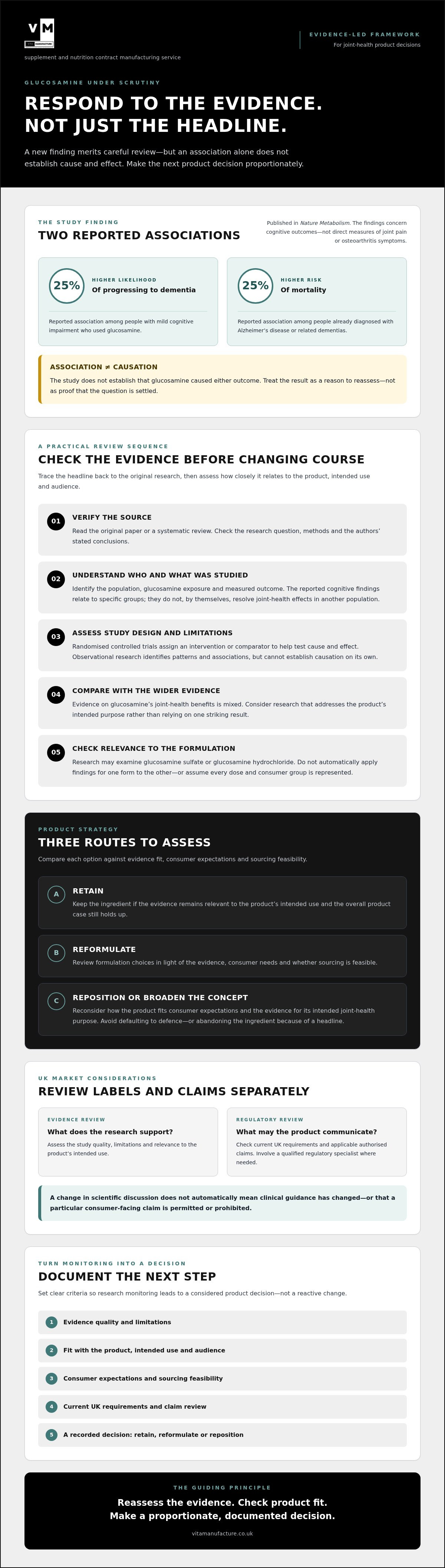
What has changed, and what remains uncertain? A June 2026 study published in Nature Metabolism brought glucosamine back into the spotlight by reporting associations between its use and cognitive outcomes. Among people with mild cognitive impairment, glucosamine use was associated with a 25% higher likelihood of progressing to dementia. Among people already diagnosed with Alzheimer’s disease or related dementias, it was associated with a 25% higher mortality risk. These findings deserve careful review, but they don’t establish that glucosamine caused either outcome.
For a joint-health brand, the commercial question is not simply whether to keep or remove a familiar ingredient. It’s whether this evidence is relevant to the product’s intended use, audience and claims, and whether it changes the overall evidence assessment. Glucosamine is under new scientific scrutiny. What should joint-health brands consider next? Start by verifying the original paper’s design, population, exposure definition and limitations, rather than relying on a headline or a summary alone.
What does “scientific scrutiny” mean for a familiar ingredient?
Scrutiny can mean reassessing efficacy, safety, study quality or how outcomes are measured. Here, the reported outcomes concern cognitive decline and mortality in specific groups; they are not direct measures of joint pain or osteoarthritis symptoms. The wider evidence on glucosamine’s joint-health benefits is mixed, so this study should be considered alongside research that addresses the product’s intended purpose.
New evidence is a reason to reassess a decision, not proof that the question is settled. A change in scientific discussion also doesn’t automatically mean clinical guidance has changed or that a particular consumer-facing claim is permitted or prohibited. Brands should check current UK requirements and applicable authorised claims separately, with a qualified regulatory specialist, before revising labels or marketing.
Which glucosamine question is the research actually asking?
Keep the research question in view: who was studied, what health condition did they have, what intervention or exposure was assessed, and what outcome was measured? The 2026 report concerns glucosamine use and cognitive outcomes in people with mild cognitive impairment or diagnosed dementia. It doesn’t, by itself, resolve whether glucosamine supports joint symptoms in another population.
Form also matters when reviewing joint research. Studies may examine glucosamine sulfate or glucosamine hydrochloride, and findings for one form shouldn’t automatically be applied to the other. The Glucosamine overview summarises these forms and research on osteoarthritis, but primary studies and systematic reviews should guide an evidence assessment. For broader product-development considerations, see the article on arthritis supplement development. This section evaluates brand decisions, not individual treatment choices; consumers should seek appropriate healthcare advice about their own use.
How to evaluate glucosamine evidence without overreading a headline
Before changing a product, trace the headline back to the research. Use a consistent appraisal process so one striking result is weighed against the wider evidence, not treated as a strategy on its own.
Start with the original study or a systematic review, then check the publication date, research question, methods and authors’ stated conclusions. For a review, look at how studies were found and selected, and whether the authors explain differences between them. The National Center for Complementary and Integrative Health’s overview of scientific evidence on glucosamine is a useful starting point for understanding why findings from clinical trials have not always aligned.
Study design matters. A randomised controlled trial assigns participants to an intervention or comparator, helping researchers test whether the intervention may have caused an outcome. Observational research examines patterns in real-world behaviour or health records; it can identify associations, but other differences between groups may contribute. Neither design answers every question, so consider what each can support and whether separate studies reach consistent conclusions.
Do the study population and outcomes match your intended audience?
Compare participants’ ages, health status, diagnosed conditions and follow-up with the audience and positioning you have in mind. Then check what was measured. Pain scores, physical function and structural changes to a joint are distinct outcomes; a result for one shouldn’t be presented as proof of another. Record the study’s own limitations, such as sample size or follow-up period, only where the paper identifies them or its methods substantiate the concern.
Does the evidence apply to your ingredient and finished product?
Match the intervention to your proposed specification: glucosamine form, dose, duration and whether it was taken alone or with other ingredients. Evidence for glucosamine sulfate, for example, doesn’t automatically establish the same effect for glucosamine hydrochloride. Nor does evidence for a studied intervention validate every finished product with a different dose, blend or delivery format.
Turn the evidence into a clear rationale for the proposed specification, and note where uncertainty remains. The existing supplement formulation development guide can help frame this evidence-to-specification step. If your review supports further development, a measured discussion with a product-development partner such as Vita Manufacture’s product development team can help connect the validated concept with formulation and manufacturing considerations.
Should joint-health brands reformulate, retain glucosamine or broaden the concept?
There’s no single response that suits every brand. Compare the evidence with the product’s intended role, customer expectations and practical feasibility before deciding whether to retain, adjust or broaden the concept. A different ingredient isn’t automatically a better-supported replacement: assess its evidence and suitability on its own merits.
When might a brand retain glucosamine while reviewing its evidence?
Retention may be reasonable to explore if the current ingredient form and specification correspond with the evidence relevant to the product’s intended role. That doesn’t justify stronger efficacy or safety claims. Document the rationale, identify evidence gaps and set a review point for new research or changes in consumer needs. Resources such as Mayo Clinic’s overview of research on glucosamine use can inform context, but shouldn’t replace product-specific evidence appraisal.
When might a broader joint-health concept merit exploration?
Start with a defined consumer need, not a fashionable ingredient list. Explore options through consumer insight and formulation feasibility, then assess each proposed ingredient for relevant evidence, quality requirements, sourcing and regulatory status. Don’t present alternatives as proven substitutes unless robust, product-relevant evidence supports that conclusion. A custom supplement formulation checklist can help organise the questions to resolve before specifications are set.
Make the decision proportionate. If a direction is supported, product development can translate the validated concept into a manufacturable formulation, with regulatory review considered before consumer-facing claims are finalised.
What joint-health brands should review in claims, labels and product validation
Scientific evidence and permission to make a consumer-facing claim are separate questions. A study may inform internal product decisions, but it doesn’t automatically justify a statement on packaging or in advertising. Review the evidence, proposed wording and finished product as connected parts of one decision, and check current UK requirements before anything goes live.
How should brands communicate uncertainty responsibly?
Use clear, measured language that reflects what the evidence actually shows. Avoid guarantees, overstated benefits or wording that implies glucosamine treats, prevents or cures a disease. Assess the whole message, not just individual phrases: a headline, image, product name or combination of statements can create an impression that goes beyond the supporting evidence.
Review every consumer-facing touchpoint, including labels, adverts, websites and supporting product pages. A careful explanation on one page won’t necessarily balance an overconfident headline elsewhere. Before publication, ask a qualified regulatory specialist to check each proposed health claim against current UK requirements and applicable authorised claims. Don’t assume that a claim used in another market is suitable for the UK.
What product checks belong in a development review?
Claims need to match the product that will actually be made. Review the ingredient’s identity and specification, check sourcing documentation, and confirm that the proposed formulation suits its intended role. If the formula or ingredient source changes, reassess whether the evidence rationale and proposed wording still apply.
Build technical checks into the review with relevant partners. Consider stability, quality controls and whether the formulation can be manufactured consistently to its intended specification. These checks support product quality; they don’t establish a health benefit or authorise a claim. Keep the distinction clear in development records and marketing review.
Evidence: What supports the product’s intended purpose?
Wording: Does every statement stay within the evidence and current UK requirements?
Product: Do identity, sourcing, formulation and quality checks match the specification?
Production: Have stability and manufacturability been considered with appropriate technical partners?
A documented review gives your team a defensible basis for retaining or updating a concept, without turning scientific uncertainty into a consumer promise. Once the evidence and market need support a clear direction, explore Vita Manufacture’s product development support to consider how a validated concept could progress towards formulation and manufacture.
A practical next-step plan for glucosamine and joint-health product development
Make the next move a documented decision, not a reaction to a headline. Build a review record that explains what prompted the assessment, what the evidence can support and what would lead the team to retain, revise or pause the concept.
Use a simple decision sequence:
Define the question: Record the target consumer, intended product role, current specification and research that triggered review.
Assess the evidence: Note study quality, relevance to the product and any important uncertainty.
Check the proposition: Review consumer need, claims, ingredient sourcing and formulation feasibility.
Agree the outcome: Document the decision, its rationale, outstanding actions and when new evidence should prompt another review.
Set criteria before debate begins. Scientific, regulatory, commercial and manufacturing stakeholders should agree what evidence or feasibility concerns would justify a change. For example, a form or dose mismatch may call for further assessment, while unclear consumer demand may point to market research rather than immediate reformulation. A supplement manufacturer selection guide can also help teams structure questions for prospective manufacturing partners.
What should a brand team do before commissioning a reformulation?
Bring a concise brief to the discussion: the decision to be made, intended audience, current formula and evidence prompting the review. Add the desired product role, existing claims and known supply or quality constraints. Agree who will assess evidence, regulatory considerations, commercial fit and manufacturability, and define what would count as sufficient support to proceed. This prevents a formulation change from becoming a substitute for an unresolved strategy question.
How can a development partner help move from review to launch planning?
Once the concept has a clear rationale, a development partner can support distinct stages: formulation translates the brief into a proposed specification; regulatory guidance informs review of the product and claims; manufacturing planning considers whether that specification can be produced; logistics supports the route beyond production. Pilot work or market research may help test a validated concept before scale-up. Commercial feasibility and technical validation should inform that decision.
Vita Manufacture supports supplement product development, regulatory guidance, manufacturing and logistics. If your evidence review has established a clear direction, discuss your next supplement development project as an optional step towards a considered product plan.
Make your next joint-health decision evidence-led
New scrutiny calls for a measured response, not an automatic defence or a rushed reformulation. Verify what the research actually examined, assess how well it fits your product and audience, then document why you’ll retain, revise or broaden the concept.
Keep the evidence, consumer-facing claims and finished-product checks connected, but treat them as distinct reviews. Check proposed wording against current UK requirements with a qualified regulatory specialist, and consider consumer relevance and manufacturing feasibility before committing to a change. A clear rationale makes your next step easier to explain and review as evidence develops.
When your review supports moving forward, Vita Manufacture offers product development with formulation, regulatory guidance, manufacturing and logistics support. Its manufacturing operation is described as ISO 22000:2018-certified; confirm the current certification scope and wording before publication or reliance.
Discuss your next supplement development project and explore a considered route from validated concept to product planning. With a disciplined process, your brand can respond to scrutiny confidently while keeping long-term product quality and commercial fit in view.
Frequently Asked Questions
What new scientific scrutiny is glucosamine facing?
A June 2026 study published in Nature Metabolism reported associations between glucosamine use and cognitive outcomes in people with mild cognitive impairment or diagnosed dementia. It brought additional safety questions into discussion, but an association doesn’t establish cause and effect or settle glucosamine’s role in joint-health products. Before publication, verify the paper’s design, participants, exposure and limitations against the original source, and distinguish its findings from any change in clinical guidance.
Does new research mean joint-health brands should stop using glucosamine?
No. A research update should prompt a structured review, not an automatic decision to retain or remove the ingredient. For brands asking whether they should reformulate or adjust their portfolio, start by comparing the study’s design, population, outcomes and glucosamine form with the product rationale. Then review product quality, current regulatory requirements and evidence for every consumer-facing statement before deciding whether any change is justified.
How should a brand assess a study about glucosamine?
Start with the original publication and identify its study type, participants, intervention, comparator, outcomes and follow-up. Check whether the form and dose resemble your proposed product, and whether the measured outcome supports its intended positioning. Consider the authors’ stated limitations and compare the result with other relevant evidence, including systematic reviews. Before changing packaging or marketing, ask scientific and regulatory specialists to review your interpretation and proposed next steps.
Can brands combine glucosamine with other joint-health ingredients?
Yes, a combination can be explored, but adding ingredients doesn’t automatically make a product more effective. Assess the evidence for each ingredient and for the proposed combination, then consider formulation compatibility, quality specifications, sourcing and intended consumers. Check applicable claims before communicating benefits. A development partner can help assess formulation and manufacturing feasibility, while decisions about scientific support and regulatory compliance should be informed by current evidence and advice from qualified specialists.
What claims can UK brands make about glucosamine supplements?
Only use claims that have been checked against current UK requirements and the relevant authorised claims framework. A finding in a scientific paper doesn’t by itself permit a consumer-facing health claim, and general wording about joint health may still need careful review. Assess packaging, advertising and website content together, since the overall impression matters. If the permitted wording or its application is uncertain, seek advice from a qualified regulatory specialist before publication.
What should a brand do before reformulating a glucosamine product?
First, document why a change is being considered, the target consumer, the current specification, the evidence prompting review and the commercial objective. Compare options for evidence fit, product quality, manufacturability, claims and consumer relevance. Check the requirements for any proposed ingredients and statements. If the concept remains uncertain, pilot development or market research may help test it before a decision to scale production is made.
How can supplement manufacturers support a glucosamine product review?
A suitable development partner can help translate a brief into formulation options, consider manufacturing feasibility and coordinate relevant quality and regulatory reviews. Vita Manufacture supports supplement product development, formulation, regulatory guidance, manufacturing and logistics. Your brand remains responsible for its product strategy and claims, so agree responsibilities clearly. Ask prospective partners how they document specifications, manage development stages and support the move from a validated concept towards production.


